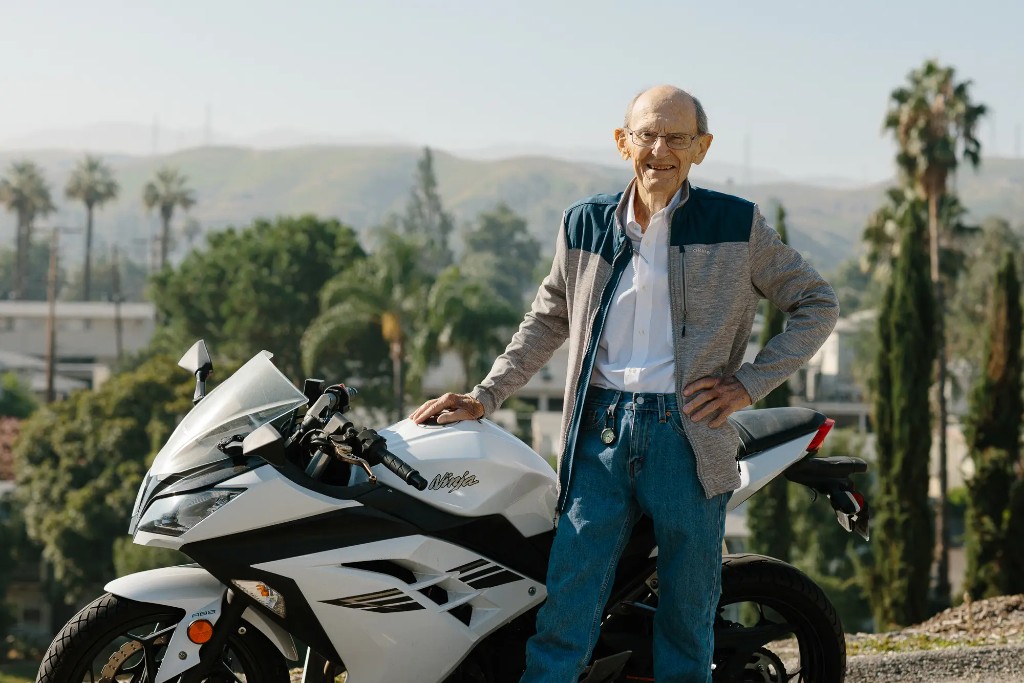
David J. Baylink standing beside his white Kawasaki Ninja in the hills above Loma Linda, California

A Novel · Available Now

The Gift

David J. Baylink, MD

Sixty years at the bench. Six hundred papers. One question a laboratory was never built to answer — and a boy who finally asked it.

“Curiosity, combined with rigor and tenacity, leads to something valuable to humanity.”
The plaque on his office wall
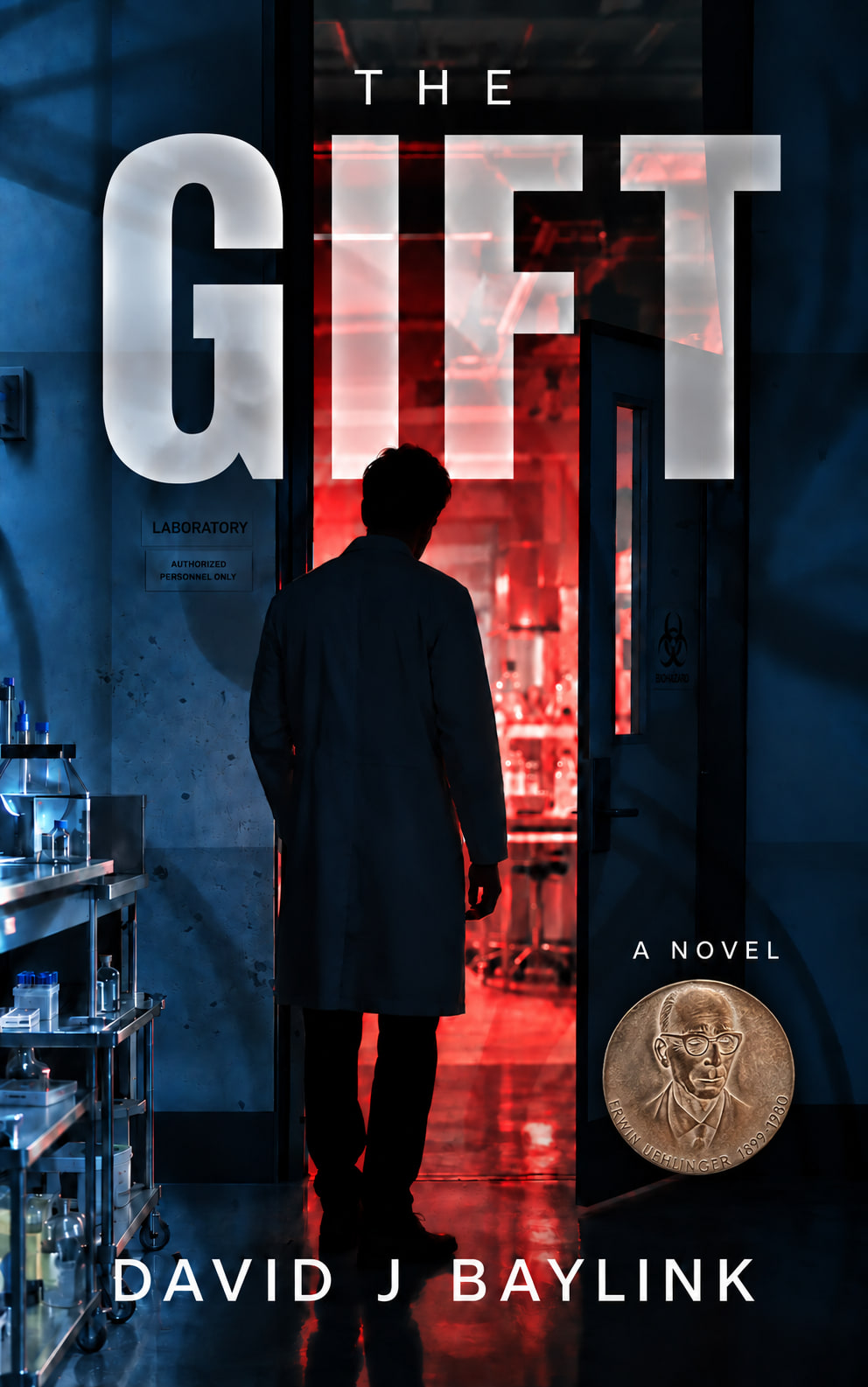
Cover of The Gift, a novel by David J. Baylink
Fiction · Autobiographical novel First edition · 2026 ISBN 979-8-1702-9449-8

The first novel

The Gift


David Baylink is thirty-five, the youngest physician ever raised to his university’s medical faculty to be elected into the American Society for Clinical Investigation, and he has arranged his life so that almost nothing can interrupt the work.

Then a young man on a Honda pulls into the parking space beside his motorcycle, twenty minutes early for an interview. Carlos Thompson can do the one thing Baylink’s laboratory cannot — reach into a living cell and rewrite a single instruction — and he is charming, hungry, and disconcertingly like the man across the desk. On the same morning, a reviewer’s letter arrives: one finding, he writes, could not be reproduced. It is very likely nothing at all.

The Gift follows the four decades that open out of that single morning — calcium and the slow loss of bone, sepsis, a chase across the Netherlands, an FBI file, three verdicts and a fourth letter, and a scientific scoreboard that keeps its own accounts. It is a novel about a man who believed that the work was the whole definition of a life, and about the nephew who quietly proved otherwise: a boy named Nikki, a tennis court, a failing kidney, and a stranger who chose to give.

“I want the boy years from now who will live because somebody stayed late at the bench and solved the right problem.”

The road is patient. The road keeps its accounts. The road collects.
Chapter One · The Needle’s Eye

Read the opening

Chapter One — The Needle’s Eye

San Timoteo University · March 2018

There is a kind of cold the valley keeps for the tail of winter, a thin and borrowed cold that knows its days are numbered, and it lay over San Timoteo that morning late in March of 2018 like a hand laid lightly on the land before the long heat of the year came up to take it away. It was six o’clock. The sky held no sun yet and no color either, only a pale and even light, and against that paleness the San Bernardino Mountains stood up in the north still wearing the dark, the snow on the high shoulders of San Gorgonio gone the gray of ash and waiting on the dawn to set it burning. Below the house the orange groves ran partway up the hill. Their blossom came to me on the still air, sweet and heavy, faintly sorrowful, the way a sweetness always is when you know it cannot last.

A man’s life, if he is honest about it, is mostly the mornings he does not remember. This was not going to be one of those. I did not know that yet. We never do. The day comes up the same gray color as all the others, and gives no sign of what it is carrying, and a man locks his door and goes out to meet it as though it owed him nothing.

I crossed to the motorcycle, my breath going up white in the cold. The helmet I carried was a costly thing, full-faced and sound, and on the side of it I had paid a man to paint a small black picture of a truck’s tire. It was an ugly little emblem, and I had wanted it there. Once, on a road not unlike Barton, a truck had run over my foot and broken it, and the foot had healed clean and given me back to my tennis and my skiing without a word of complaint — but it had taught me the lesson the road teaches every man who rides long enough. The road is patient. The road keeps its accounts. The road collects. Every rider goes down. The ones who forget it go down soonest, and hardest, and some of them for keeps.

I swung onto the bike and felt the cold of the seat come up through my slacks. I was dressed that morning like a man bound for a banquet and not a laboratory — pressed slacks, good shoes, a bowtie — so that the helmet was the only honest thing about me. There are men who ride to feel free, and men who ride only to feel something at all, and I have never been certain which of the two I am. The danger was not a thing I rode in spite of. It was the thing I rode for, and a man who will tell you the truth about that about himself will tell you the truth about most things.

The trouble began at the foot of my own driveway, where the road fell away down a slope steep as a canyon wall and near as narrow. On the right an orange grove leaned out over the path, the new leaves of spring wet and ticking in the cold. On the left the ground dropped clean away into nothing. There was no room on that slope for a mistake of any size.

I went down it slow. The grove crowded in on the one hand and the cold came up off the drop on the other, and then at the very bottom the trap sprang. Two cars came to the foot of the slope in the same breath, one from the left and one from the right, and stopped there nose to nose and sealed the only way out. It was a thing that could not happen. It happened anyway. I have noticed that the things which cannot happen are the ones a man had best be ready for.

My mouth went dry. I held the grips till my forearms burned and leaned my weight forward to keep the bike from going over on the grade. There was no flat ground anywhere under me to set it down on. I could feel my heart up high in my throat. I measured the gap behind the nearest car and measured it wrong — it was smaller than I had read it. I let the brake off a slow inch at a time and stopped with the front wheel trembling a hand’s width from the bumper. One inch more and the bike and I both would have gone down together.

Then the car ahead of me moved. A space opened no wider than a doorway, and I did not stop to think on it. I turned the throttle and the engine came up under me like something glad to be asked, and I put the bike through the eye of that needle and out the other side, and then I was through, upright in the road with all of it behind me, and the breath went out of me in a rush.

I am a scientist by trade, and I distrust what I cannot measure. But I am also a Seventh-day Adventist, and I know the difference between luck and grace, and riding down out of that morning I knew which of the two had just been spent on my account.
Lines from the book

What the novel is made of

“I have noticed that the things which cannot happen are the ones a man had best be ready for.”
Chapter 1 · The Needle’s Eye
“The question didn’t leave with the fear — it just went quiet, the way a splinter goes quiet under skin, still there, still working its way toward the surface.”
Chapter 1 · The Needle’s Eye
“It was closer to duty that had not yet found out it wanted to be something more.”
Chapter 5 · Nikki
“That is the cruelty of a grant. You pour months into it, seal it, and hand it to a committee of strangers who will decide your next three years in a single afternoon.”
Chapter 6 · The Carwash
“A closed gap, in science, is sometimes louder than an open one — because it tells you the one thing you changed was the thing that mattered.”
Chapter 8 · Calcium, the Communicator Ion
“I had kept score most of my life. That night the scoreboard favored me.”
Chapter 22 · The Scientific Scoreboard
“There was no run-it-again for Nikki.”
Chapter 25 · Waiting Was the Work
“Those were not lesser ambitions. They were simply ambitions that did not fit on a CV.”
Chapter 25 · Waiting Was the Work
“The work had not become less important. It had acquired company.”
Chapter 26 · The Gift of Freedom
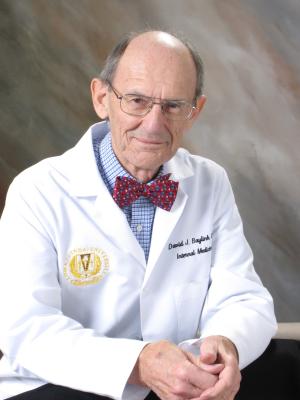
Dr. David J. Baylink in his white coat at Loma Linda University

David J. Baylink, MD · Loma Linda University

The author

He has been asking the same question since 1957.


David J. Baylink, MD, is a Distinguished Professor of Medicine at Loma Linda University, where his translational research spans sepsis and calcium endocrine signaling. He is the author of more than six hundred scientific publications, placing him in the top ten percent of physician-scientists by publication output, and has held continuous federal research funding spanning the VA, the NIH, and the Department of Defense.

He also heads the university’s Division of Regenerative Medicine, still commutes to the laboratory on a Kawasaki Ninja, wears a bowtie while doing it, and answers questions about longevity with a shrug: good genetics, and he loves his job. His favorite expression is “Let ’er rip!”

The Gift is his first novel.

More about David

600+
Scientific publications
1957
MD, Loma Linda University
26
Chapters in The Gift
1
Motorcycle, still ridden

The science behind the story

The research in this novel is real.


The sepsis work and the calcium endocrine investigations described in The Gift are drawn from research the author has pursued for decades — much of it still ongoing. Bone that quietly gives way with age. Calcium as the cell’s messenger. The long, unglamorous arithmetic of a laboratory that runs on grant money the way an engine runs on fuel.

The novel is unusually patient about how discovery actually happens. In one chapter a technician reaches for the wrong bottle, the calcium in the culture medium comes up short, and a week of work is ruined. The experiment is already on its way to the trash when the narrator stops in the corridor with his coat over his arm and says: Don’t throw that out. Run it again.

What is invented is everything around it. The people, the relationships, and the events surrounding the science have been reshaped, combined, or imagined outright. Some of what happens to the character carrying the author’s name did not happen to him.

Read the author’s note

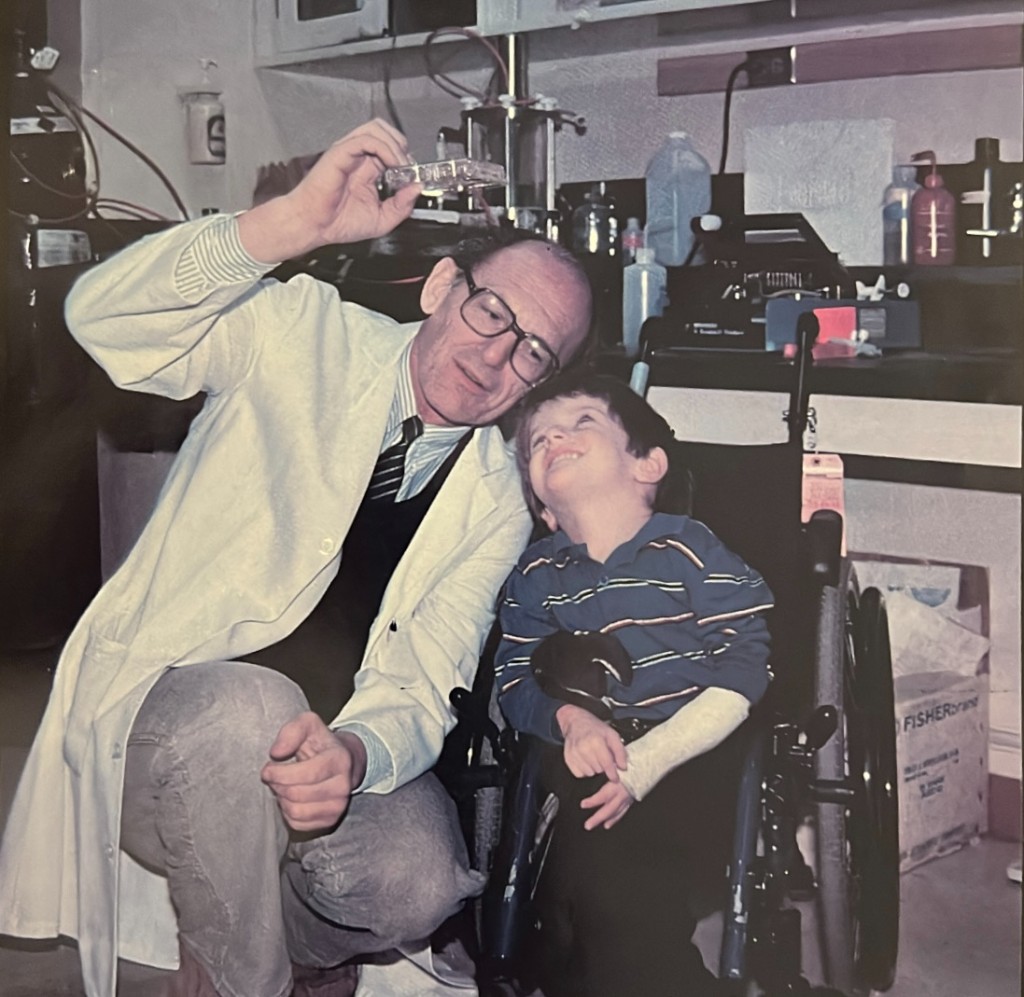
Dr. Baylink in his laboratory holding a culture plate up to the light beside a boy in a wheelchair

In the laboratory — the reason the work matters